


Air filtration in pharmaceutical cleanrooms
A practical guide to contamination control, cleanroom classes, HEPA performance, airflow architecture, filter qualification and lifecycle cost in drug-manufacturing facilities.

Air is a process input—not just a comfort utility.
Air can contact exposed product, product-contact surfaces, containers and closures. In aseptic processing there is no final sealed-container sterilization step; protecting the process environment is therefore essential.
Four routes to product risk
Microbes: people or incoming air can carry bacteria, yeasts and mold. Particles: fibers, skin flakes or process debris can enter product—and particles can carry microorganisms. Endotoxin: sterilizing-grade filters and moist heat are not a dependable endotoxin-removal step. Cross-contamination: shared air can transfer potent or allergenic powders.
A cautionary lesson
The 2012 fungal meningitis outbreak linked to contaminated compounded injectable methylprednisolone ultimately involved 751 cases and 64 deaths, according to the CDC's 2013 update. Cleanroom control, maintenance and trend response are patient-safety controls.
Requirements are layered. There is no universal “HEPA grade” for every room.
Binding regulation, regulator guidance, international standards and the product's approved application all shape the facility design. Distinguish mandatory text from guidance and common engineering practice.
| Framework | Air-control contribution | Status |
|---|---|---|
| 21 CFR 211.42(c)(10), 211.46 | US CGMP provisions covering filtered air supply to aseptic areas, pressure, environmental controls, and appropriate control of microorganisms, dust, humidity and temperature. | Binding US CGMP |
| FDA aseptic processing guidance (2004) | Benchmarks include ISO 5 critical areas, ISO 7 adjacent support areas, pressure differentials, HEPA integrity tests, airflow visualization and media fills. | Non-binding guidance |
| EU GMP Annex 1 (2022 revision) | Grades A–D, particle and microbial limits, CCS, first-air protection, monitoring, qualification and appropriate-efficiency filtration. | Binding in EU |
| ISO 14644 series | Cleanroom particle classification, monitoring, test methods, requalification and design guidance. | Voluntary / referenced |
| ISO 29463 / EN 1822 | EPA, HEPA and ULPA classification and test methods at the most penetrating particle size (MPPS). | Filter classification |
| WHO TRS 961 Annex 5 | HVAC design, qualification and maintenance guidance, particularly for non-sterile dosage forms. | Guidance |
FDA uses ISO class numbers; EU GMP Annex 1 adds operational states, microbial limits and a facility-wide CCS. Always verify the current governing text and site-specific obligations.
Cleanroom class connects activity, particle limits and environmental control.
These selected reference values help orient design discussions. They are not a substitute for the full tables, sampling plan, current regulation or site CCS.
| EU GMP grade | Typical activity | ISO equivalent (at rest / in operation) | Viable active air limit (CFU/m³) |
|---|---|---|---|
| A | Aseptic filling, open sterile connections, open transfer | ISO 5 / ISO 5 | No growth |
| B | Background to Grade A in conventional aseptic operations | ISO 5 / ISO 7 | 10 |
| C | Less-critical sterile manufacturing; e.g. solution prep before filtration | ISO 7 / ISO 8 | 100 |
| D | Component handling after washing and support activities | ISO 8 / not predetermined | 200 |

Figure 1. Conceptual zoning only. Actual room relationships, pressure cascade and classification depend on the process, barriers and CCS.
Read the test method—not just the efficiency number.
General-ventilation ratings and high-efficiency filter classes use different test bases. Cross-references between standards are approximate, not direct equivalences.
ASHRAE 52.2
General ventilation; size-resolved efficiency across defined particle-size ranges. MERV 1–16.
ISO 16890
General ventilation; classifications include ePM₁, ePM₂.₅, ePM₁₀ and coarse, with discharge-state testing.
EN 1822 / ISO 29463
EPA, HEPA and ULPA performance tested at the most penetrating particle size; leak testing is distinct from media efficiency.
| EN 1822 class | Overall efficiency at MPPS | Local efficiency / leak limit | Overall penetration |
|---|---|---|---|
| E10 | ≥85% | Not leak-tested | ≤15% |
| E11 | ≥95% | Not leak-tested | ≤5% |
| E12 | ≥99.5% | Not leak-tested | ≤0.5% |
| H13 | ≥99.95% | ≥99.75% | ≤0.05% (1 in 2,000) |
| H14 | ≥99.995% | ≥99.975% | ≤0.005% (1 in 20,000) |
| U15 | ≥99.9995% | ≥99.9975% | ≤0.0005% |
Typical staged design practice may use coarse MERV 6–8 prefilters, MERV 11–13 mid-stage, MERV 14–15 fine filtration and terminal H13–H14 HEPA where needed. The sources reviewed do not mandate one filter grade per room class; determine the train by risk assessment and applicable requirements.
Filters work only when the complete air system works.
Protect the critical point with the right filter train, pressure direction and airflow pattern—and verify it under operating conditions.
Coarse prefilter
Captures larger dust and lint; protects coils and downstream filters.
MERV 6–8 · typicalPleated / pocket
Handles much of the particulate load and extends final-filter life.
MERV 11–13 · typicalFine final stage
Provides finer protection upstream of terminal filtration.
MERV 14–15 · typicalTerminal HEPA
Final barrier at room discharge or critical-flow unit.
H13–H14 · selected by designIllustrative supply-air train only. The actual architecture and filter grades depend on the facility, process, airflow and risk assessment.
Maintain first-air protection
At critical points, HEPA-filtered air should sweep over and away from exposed product. FDA and Annex 1 expect airflow visualization, including dynamic conditions; Annex 1 calls for video records at rest and in operation.
Design pressure direction
Cleaner areas are commonly maintained at higher pressure. FDA cites 10–15 Pa as a common target between different classifications; Annex 1 gives at least 10 Pa as a guidance value between adjacent grades. Critical differentials require monitoring and response.
Don't copy an ACH number blindly
Air-change rates depend on heat, particle generation, room recovery and process loads. Annex 1 and ISO 14644-1 do not prescribe a universal ACH. Grade A unidirectional flow is designed by velocity—about 0.45 m/s ±20%—not by room ACH.
Account for people and equipment
Rapid movement, obstructions, turbulence, eddies and particle-collecting ledges can disrupt the flow pattern. Locate supply, return and exhaust to avoid dead zones and protect exposed product.
Specify construction and service conditions alongside the rating.
Filter integrity depends on reliable media, fit and material compatibility—not only the class printed on the label.
| Component | What to specify | Why it matters |
|---|---|---|
| Media | Microglass for HEPA; suitable synthetic or glass media for prefilters; non-shedding construction. | Reduces fiber shedding and supports consistent performance. |
| Frame & seal | Corrosion-resistant, cleanable construction; compatible gasket, gel seal or knife-edge arrangement; secure fit. | Bypass around the frame can defeat the filter's rated efficiency. |
| Test access | Upstream injection and downstream sampling ports; service access for in-situ testing. | Enables installed-filter challenge and leak scans. |
| Moisture & chemistry | Drainage, humidifier placement, wet-side protection; compatibility with cleaning agents and VHP where used. | Wet filters can raise pressure drop and support microbial growth; chemicals can damage materials. |
| Temperature | Heat-resistant media, seals and frame for depyrogenation tunnels or dry-heat ovens. | Ordinary HVAC filters may not tolerate high-temperature service. |
| Documentation | Factory efficiency and leak-scan report, serial traceability, installation date and initial differential pressure. | Creates the baseline for qualification, maintenance and inspection records. |
Qualification turns filter selection into verified performance.
Installation, leak testing, airflow checks and ongoing data trends reveal failures that a rating label cannot.
Install & challenge
Leak-test installed filters using an appropriate aerosol challenge; scan the entire face, frame and seal. FDA gives twice-yearly testing of the aseptic processing room as an example and recommends additional testing after relevant disturbances or failures.
Measure the room in operation
Check airflow velocity and uniformity, pressure differentials and particle counts. Use airflow visualization to demonstrate sweeping protection with people and equipment present.
Trend & act
Trend pressure drop across filter stages and room pressure; investigate alarms, excursions and changes. Re-test after HEPA replacement, repair or disturbance and re-evaluate airflow after changes.

Figure 2. Practical lifecycle loop for filter and cleanroom performance assurance.
Match the filter architecture to the cleanroom application.
AccuraFil offers industrial and commercial filter formats that can support different stages of a pharmaceutical HVAC filtration train. The appropriate product depends on the required cleanroom grade, AHU design, airflow, pressure-drop limits, sealing arrangement, test access and qualification plan.
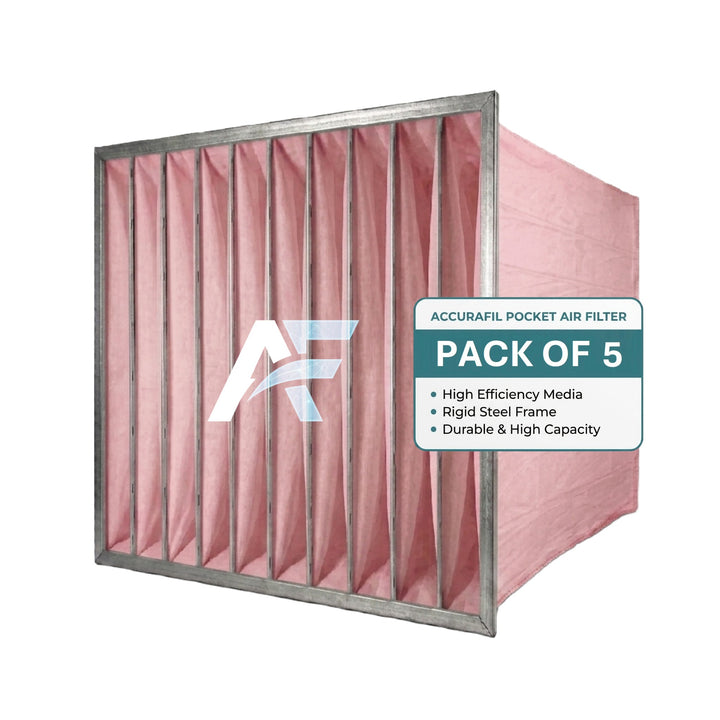
Pocket Air Filters
Deep-pocket filters provide media area and dust-holding capacity for upstream HVAC stages, helping reduce the particulate load reaching finer filters.
- Useful as a prefilter or intermediate stage
- Select the efficiency class to suit the incoming air and system design
- Verify moisture exposure, airflow and loaded pressure drop
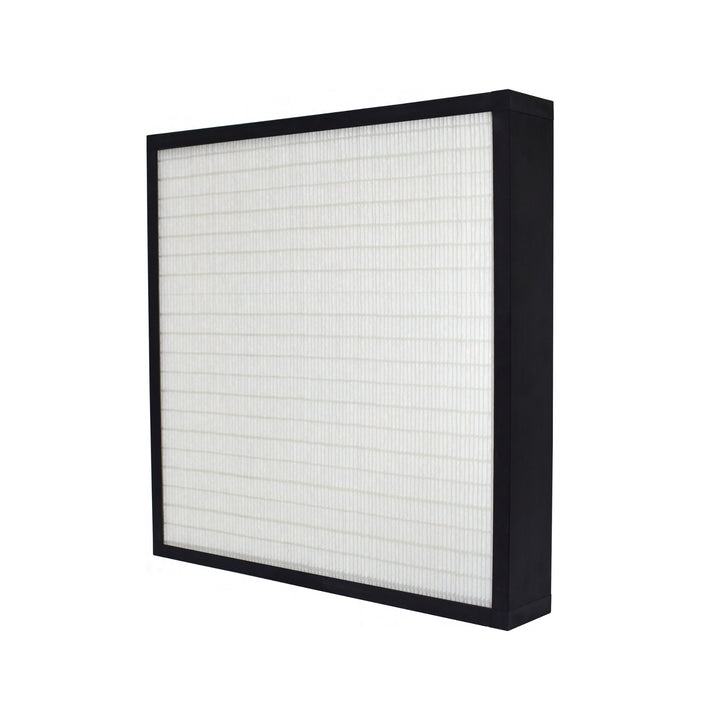
Mini-Pleat Filters
Compact pleated construction can provide fine particulate filtration where available installation depth, airflow and pressure drop constrain the design.
- Consider for intermediate or fine-filter stages
- Confirm the exact efficiency and construction offered
- Do not treat a fine filter as a substitute for terminal HEPA where HEPA is required
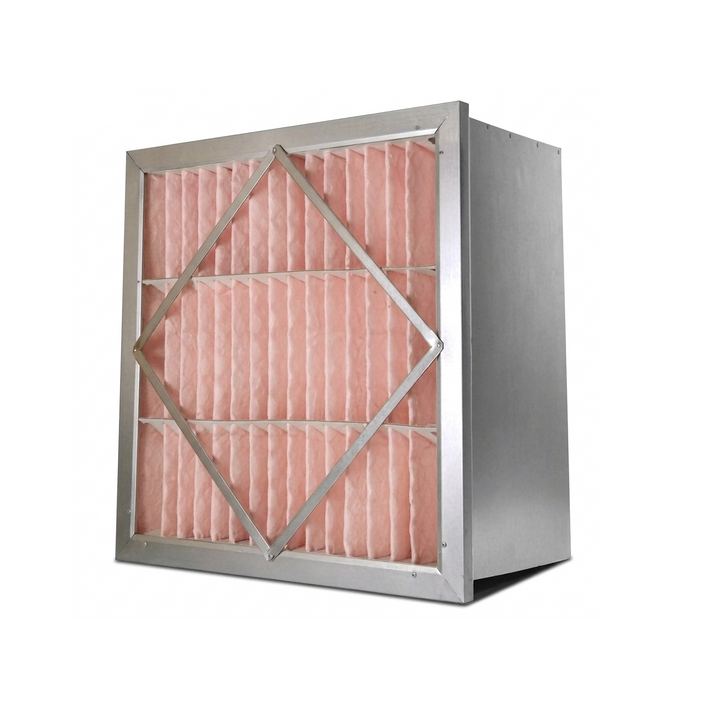
Rigid-Pac / Rigid Box Filters
Rigid deep-pleated filters are an option for HVAC systems that need stable geometry and a robust filter pack in an intermediate or final non-HEPA stage.
- Evaluate frame fit and gasket compression
- Confirm rated airflow and initial/loaded resistance
- Use the filter class specified by the facility design
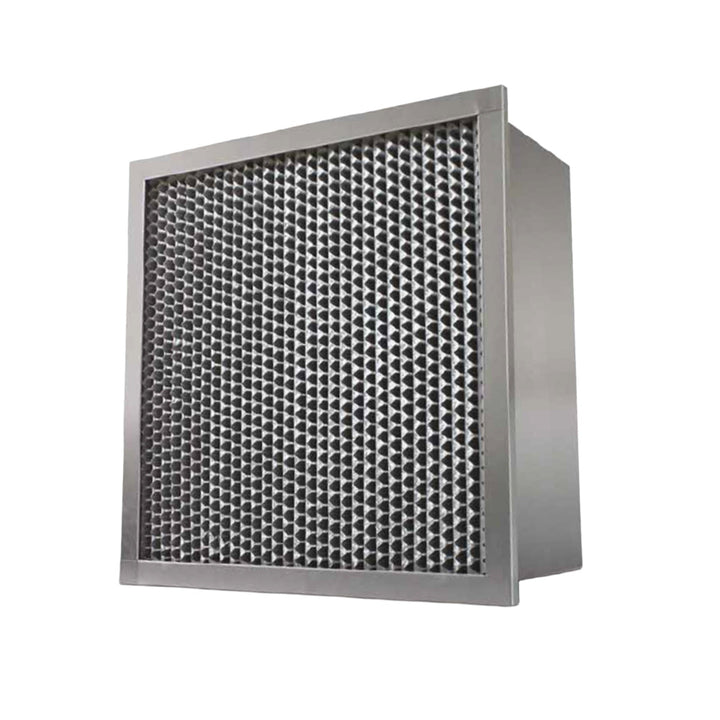
ASHRAE Cell Filters
Deep-pleated cell filters can serve as high-efficiency particulate stages in HVAC systems where the specified MERV performance is appropriate to the application.
- Potential upstream protection for terminal HEPA banks
- Compare media, header/frame design and pressure drop
- Verify compatibility with the filter rack and service procedure
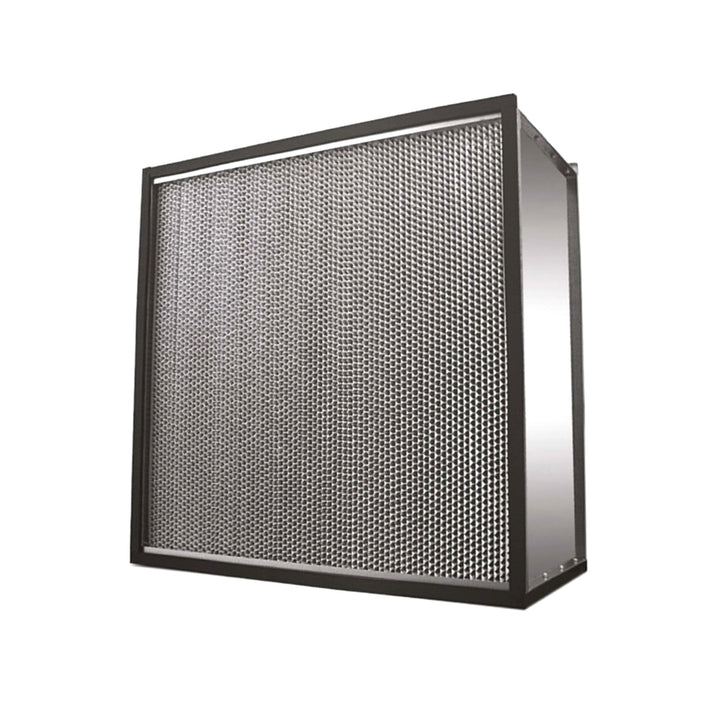
Standard- and High-Capacity HEPA Filters
AccuraFil HEPA filters are available in configurations including E12 and H13, with product-specific grades and options to be confirmed against the current specification. H13 is rated at ≥99.95% efficiency at MPPS under EN 1822.
- Individually scan-tested options are described on product pages
- Match actual dimensions, gasket/seal and housing design
- Plan installed leak testing and cleanroom qualification
Explore HEPA air filters →
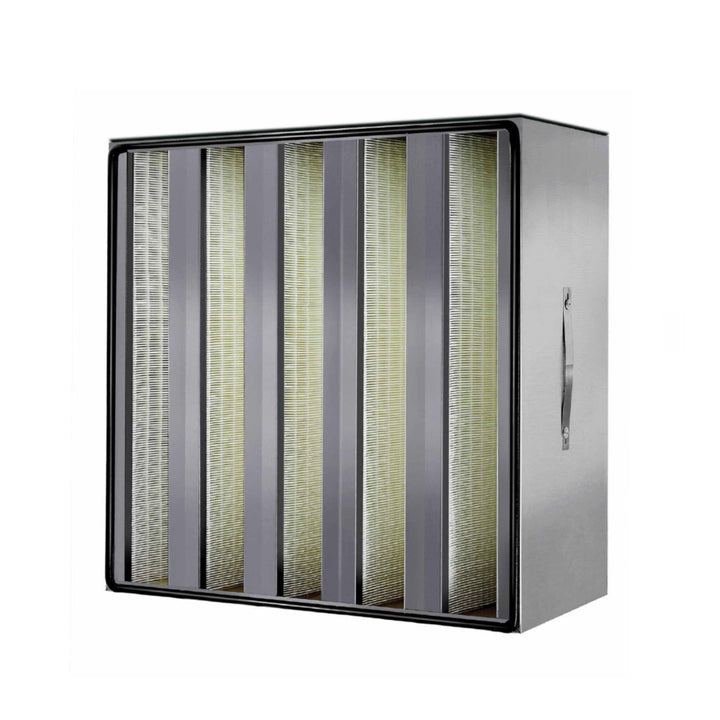
HEPA V-Bank Filters
V-Bank geometry provides a large effective media area in a compact depth and can be considered for high-airflow systems when the required HEPA grade and housing are compatible.
- Review airflow, initial resistance and fan capacity
- Confirm the specific model's EN 1822 grade and test documentation
- Check sealing, installation access and in-situ scan-test method
For product specifications, available dimensions and current configurations, visit the AccuraFil industrial air filter range or HEPA filter collection.
Lowest purchase price rarely means lowest cost of ownership.
Filter resistance affects fan energy; prefiltration can extend HEPA life and reduce replacement labor, retests and downtime risk.
Think beyond unit price
Compare purchase cost, fan energy attributable to pressure drop, maintenance labor, disposal, qualification retesting, planned downtime and batch-risk exposure. Cleanrooms can be energy-intensive because of high airflow needs.
Keep changes under control
Reduced airflow or setback strategies should be validated against pressure cascades, recovery time and process requirements. Assess proposed changes through the facility's change-control process.
11 questions for the next filter specification.
Use this prompt list to connect product risk, the actual air system and the evidence needed for qualification.
- What product, container or closure is exposed—and for how long?
- What grade or ISO class does each room require, at rest and in operation?
- What does the facility's Contamination Control Strategy require of HVAC?
- What contaminants are present in outdoor and return air: dust, pollen, spores or gases?
- What airflow does the air handler actually deliver at the filter face?
- What are initial and loaded pressure-drop limits and alarm points?
- Which filters need leak testing—and are test ports and service access provided?
- Will heat, moisture, VHP or cleaning chemistry affect the materials?
- Do solvents, odors or reactive gases need separate gas-phase media?
- How will performance be monitored, trended and documented?
- What is the lifecycle cost—not just the filter purchase price?
Selected primary references
Source pointers for key regulatory values and design principles summarized above.
- U.S. FDA. Guidance for Industry: Sterile Drug Products Produced by Aseptic Processing—Current Good Manufacturing Practice (2004). FDA guidance PDF.
- European Commission. EudraLex Volume 4, Annex 1: Manufacture of Sterile Medicinal Products (2022 revision; in operation from 25 August 2023). Annex 1 PDF.
- Health Canada. GMP guidance, Annex 1 environmental and process monitoring, including monitoring limits. Monitoring guidance.
- ISO. ISO 14644 cleanroom series; ISO 29463:2024, high-efficiency filters and filter media. ISO 29463-1:2024.
- CDC. Multistate fungal meningitis outbreak update, one year later (23 October 2013). CDC update.
- WHO. TRS 961, Annex 5: HVAC systems for non-sterile pharmaceutical dosage forms. Guideline overview.
This webpage is an editorial summary of the supplied technical report, not regulatory or engineering advice. Verify standards editions, jurisdictional adoption and site-specific requirements before design or operation.


